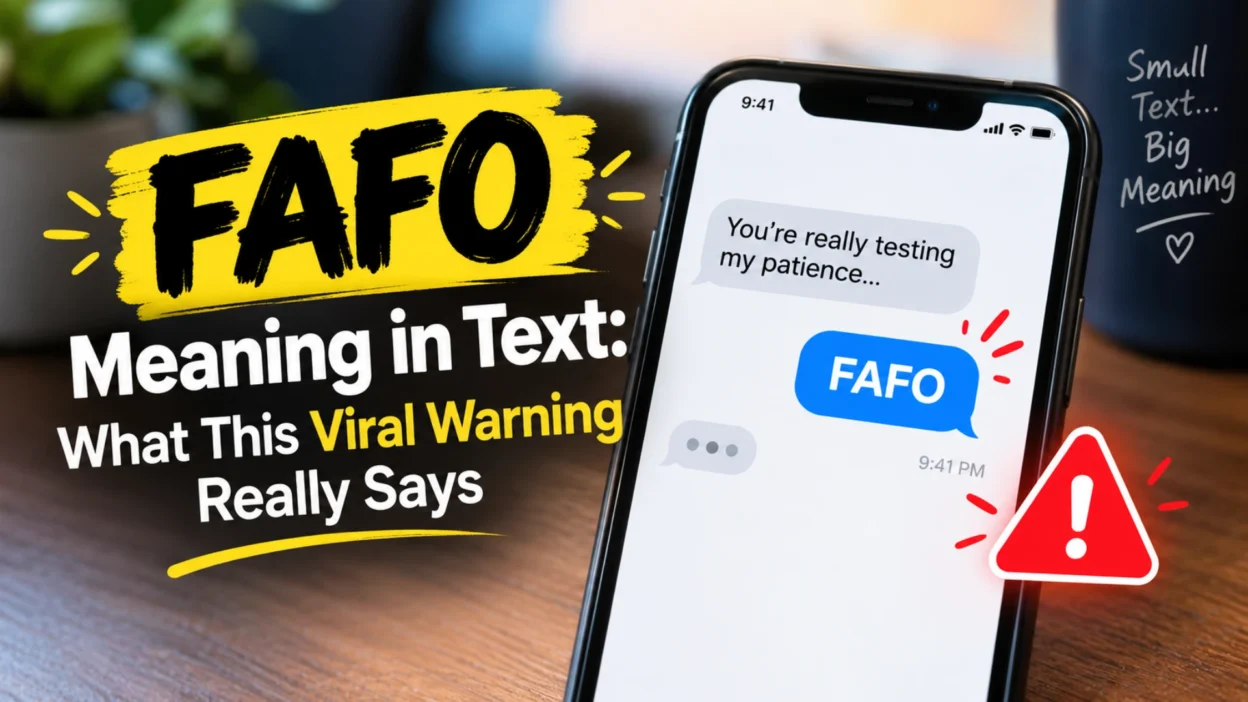
FAFO Meaning: Understanding the Popular Slang Term and How to Use It
Language changes constantly, especially in the digital age. New expressions appear on social media, become popular in online conversations, and eventually enter everyday communication. One expression that has attracted considerable attention is FAFO meaning. This short but powerful slang term is commonly used in memes, comments, text messages, and discussions about personal responsibility.
If you have encountered FAFO on TikTok, Instagram, X (formerly Twitter), Reddit, or another online platform, you may be wondering what it means and why so many people use it. Although the expression consists of only four letters, it communicates a strong message about consequences, personal decisions, and unexpected outcomes.
In this article, we will explore the FAFO meaning, its origin, how people use it, its popularity on social media, and situations in which it may or may not be appropriate.
What Does FAFO Mean?
fafo meaning stands for “F* Around and Find Out.”** It is an informal slang expression that suggests people will experience the consequences of their actions, especially when they knowingly take risks, ignore warnings, or provoke someone.
The phrase communicates a straightforward idea: if someone behaves carelessly or deliberately creates trouble, they should not be surprised when something unpleasant happens as a result.
For example, imagine someone repeatedly ignoring warnings about touching a hot surface. Eventually, they touch it and burn their hand. Someone watching the situation might respond with FAFO because the person experienced the predictable consequences of their decision.
The expression can be humorous, serious, sarcastic, or threatening depending on the situation. Its meaning is strongly influenced by the speaker’s tone and the surrounding conversation.
Although FAFO contains profanity, people frequently use the abbreviation instead of writing the complete expression. This makes it shorter and sometimes less explicit in online discussions.
The Origin and History of FAFO
The exact origin of FAFO is difficult to establish because the expression developed through informal speech rather than being introduced by one identifiable person or organization.
The complete phrase has existed in conversational English for years. It reflects a familiar cultural idea: people should understand that their decisions have consequences.
Over time, the abbreviation became increasingly recognizable in internet discussions, online communities, and popular culture.
Social media helped accelerate its popularity. Short expressions are particularly effective on platforms where users communicate through brief comments, captions, reactions, and memes. FAFO fits naturally into this environment because it communicates an entire attitude using only four letters.
The expression also became associated with discussions about confidence, boundaries, accountability, and standing up against disrespectful behavior.
Today, FAFO is widely recognized in many English-speaking online communities. However, its use is not limited to social media. People also use it in everyday conversations, workplace discussions, entertainment, and political commentary.
Why Has FAFO Become So Popular?
Several factors explain why FAFO has become such a recognizable internet expression.
1. It Communicates a Strong Message
One reason behind its popularity is its directness. Instead of writing a lengthy explanation about consequences, someone can simply use FAFO.
The expression immediately communicates that a person should accept responsibility for their behavior.
2. It Works Well in Memes
Internet memes often depend on short, memorable phrases. FAFO works particularly well because it can describe situations involving poor decisions, unnecessary arguments, and unexpected consequences.
For example, a meme might show someone ignoring several warning signs before experiencing an obvious consequence. The caption FAFO summarizes the entire situation.
3. It Represents Personal Boundaries
People sometimes use FAFO when discussing situations in which someone refuses to tolerate disrespect.
For example, a person might explain that they repeatedly warned someone not to cross a particular boundary. If that person continues ignoring the warning, FAFO may describe the eventual outcome.
4. It Creates an Immediate Reaction
The expression is memorable because it combines humor, confidence, and confrontation. Readers often understand its message immediately, making it effective in short online conversations.
How Is FAFO Used in Everyday Conversations?
Understanding the FAFO meaning becomes easier when you examine practical examples.
Here are several situations where people might use this expression.
Example 1: Ignoring Warnings
Person A: “He kept touching the electric fence even after everyone told him to stop.”
Person B: “Well, FAFO!”
In this situation, the expression suggests that the person experienced the predictable consequences of ignoring warnings.
Example 2: Disrespecting Boundaries
Person A: “I told him several times not to insult me, but he continued.”
Person B: “Sometimes people need to learn. FAFO.”
Here, the phrase communicates that disrespectful behavior can have consequences.
Example 3: Taking Unnecessary Risks
Person A: “She invested all her savings in something she knew nothing about.”
Person B: “That’s a classic FAFO situation.”
This example uses the expression to describe the consequences of making an irresponsible decision.
Example 4: Online Arguments
Person A: “He started an argument with someone and immediately regretted it.”
Person B: “FAFO!”
In this context, the abbreviation is a short reaction suggesting that the person should have anticipated the outcome.
FAFO Meaning on TikTok and Other Social Media Platforms
Social media has played an important role in making FAFO a recognizable expression.
On TikTok, users frequently include slang in video captions, comments, and humorous storytelling. FAFO is particularly popular in content involving unexpected consequences, confrontations, personal boundaries, and funny mistakes.
Instagram users also employ the expression in reels, stories, and comment sections. It can appear under videos showing someone making a questionable decision or experiencing the results of their behavior.
On X, FAFO is often used in discussions involving accountability, disagreements, and controversial situations. Its direct tone makes it suitable for short reactions.
Reddit communities also use the expression when discussing personal experiences, workplace situations, relationships, and stories involving questionable decisions.
Despite its widespread popularity, the meaning remains relatively consistent across these platforms: actions have consequences.
Is FAFO a Positive or Negative Expression?
FAFO does not have one universal emotional meaning. Whether it sounds positive or negative depends on the situation.
In some conversations, it communicates confidence and personal strength. Someone might use it to explain that they will defend their boundaries if another person repeatedly disrespects them.
In other situations, it can sound aggressive or hostile. If someone uses FAFO during a heated argument, the phrase may suggest that they are warning another person about possible consequences.
It can also be humorous. Friends may use it when joking about someone making an obviously bad decision.
Therefore, understanding the context is essential. The same abbreviation can communicate amusement, frustration, confidence, or intimidation depending on how it is used.
Is FAFO Considered Rude or Offensive?
Yes, FAFO can be considered rude because its original expression contains profanity.
Although the abbreviation looks less explicit than the complete phrase, many people understand exactly what it represents.
Whether it is appropriate depends on the audience and environment.
In casual conversations between friends, it may be acceptable, particularly when everyone understands the intended humor.
On professional platforms, however, it is generally better to avoid using it. The expression may appear disrespectful, unprofessional, or unnecessarily confrontational.
It is also important to consider the feelings of the person receiving the message. A phrase intended as a joke could be interpreted as a threat or personal attack.
If you are communicating with someone you do not know well, a more neutral expression may be a better choice.
Common Situations Where People Use FAFO
FAFO appears in different types of conversations. Understanding these situations can help you recognize its intended meaning.
Personal Relationships
People sometimes use FAFO when discussing relationships in which one person repeatedly ignores boundaries or takes another person’s patience for granted.
For example, someone might describe a situation where a friend continues breaking promises despite receiving several warnings.
Workplace Discussions
In informal workplace conversations, FAFO may describe employees who ignore reasonable instructions or repeatedly make careless decisions.
However, using the abbreviation in official emails or professional communication is usually inappropriate.
Online Gaming
Gaming communities often use FAFO when discussing players who challenge stronger opponents, ignore warnings, or make risky decisions during matches.
It may be used jokingly after someone loses a confrontation they unnecessarily started.
Sports and Competition
FAFO can also appear in sports discussions. Fans might use it when an athlete or team underestimates an opponent and eventually suffers the consequences.
Internet Humor
Memes and funny videos frequently use FAFO to describe situations in which someone makes an obviously questionable choice.
In these examples, the phrase often adds humor rather than expressing genuine anger.
FAFO vs. Similar Slang Expressions
Several other slang expressions communicate ideas similar to FAFO. However, their meanings and emotional tones are not exactly the same.
1. Play stupid games, win stupid prizes
This expression means that irresponsible or foolish behavior often leads to undesirable consequences. It is probably one of the closest alternatives to FAFO.
2. Actions have consequences
This is a more formal and less aggressive way of communicating the same general message. It emphasizes personal responsibility without using profanity.
3. You reap what you sow
This traditional expression suggests that people eventually experience the results of their actions. It is often used in discussions about fairness, responsibility, and morality.
4. Don’t test me
This phrase communicates a warning that someone should not challenge another person’s patience or boundaries.
5. Karma
Karma is often used to describe a situation in which someone experiences consequences that appear connected to their previous behavior.
Although these expressions share similar themes, FAFO usually sounds more direct, confrontational, and informal.
How to Respond When Someone Says FAFO
If someone uses FAFO in a conversation with you, your response should depend on the context.
If they are joking, you can respond humorously.
For example:
- “Lesson learned!”
- “I guess I found out.”
- “That was definitely unexpected.”
- “You might be right.”
If the conversation is serious, a calm response is usually more appropriate.
You could say:
- “I understand that actions have consequences.”
- “I know what I did, and I accept responsibility.”
- “Let’s discuss the situation calmly.”
- “There is no need to turn this into an argument.”
If the phrase feels threatening, avoid escalating the situation. You can establish a clear boundary and disengage if necessary.
Understanding the speaker’s intention is more important than reacting immediately to the abbreviation.
Should You Use FAFO in Professional Communication?
Although FAFO is popular online, it is not generally suitable for formal communication.
Professional environments usually require language that communicates ideas clearly and respectfully.
For example, instead of writing:
“FAFO if you ignore the safety instructions.”
You could write:
“Failure to follow safety instructions may result in serious consequences.”
Similarly, instead of telling a colleague that their decision was a FAFO moment, you could explain that the decision involved avoidable risks.
There is nothing wrong with understanding internet slang. However, knowing when to use it is an important part of effective communication.
Common Misunderstandings About FAFO
Despite its popularity, people sometimes misunderstand the expression.
One common misunderstanding is that FAFO always represents a physical confrontation. Although it can be used in situations involving conflict, it does not necessarily refer to violence.
Another misconception is that FAFO is always intended as a threat. In reality, people frequently use it humorously to describe everyday mistakes and predictable outcomes.
Some people also believe that FAFO is exclusively a social media expression. However, the complete phrase has roots in informal spoken English and is not limited to digital communication.
Finally, FAFO does not automatically mean that someone deserves every negative outcome they experience. Context matters, and real-life situations are often more complicated than internet jokes suggest.
Frequently Asked Questions About FAFO Meaning
1. What does FAFO stand for?
fafo meaning stands for “F*** Around and Find Out.” It is an informal slang expression suggesting that people will experience the consequences of their actions.
2. Is FAFO a bad word?
The abbreviation itself is not a conventional swear word, but it represents a phrase containing profanity. Therefore, some people consider it inappropriate in formal or professional environments.
3. What does FAFO mean in texting?
In text messages, FAFO usually communicates that someone should expect consequences after making a risky decision, ignoring warnings, or provoking another person.
4. What does FAFO mean on TikTok?
On TikTok, FAFO is commonly used in captions and comments involving funny mistakes, confrontations, personal boundaries, and unexpected consequences.
5. Is FAFO an insult?
Not necessarily. It can be used as a joke, warning, sarcastic comment, or criticism. Its meaning depends on the conversation and the speaker’s intention.
6. What is another way to say FAFO?
Common alternatives include “actions have consequences,” “play stupid games, win stupid prizes,” and “you reap what you sow.”
7. Can FAFO be used jokingly?
Yes. Friends and online communities frequently use FAFO humorously when someone makes an avoidable mistake or experiences an unexpected result.
Conclusion
Understanding the FAFO meaning provides useful insight into modern internet slang and everyday informal communication. The abbreviation stands for “F*** Around and Find Out” and expresses the idea that people must accept the consequences of their decisions.
Its popularity comes from its simplicity, memorable wording, and ability to communicate a strong message in just four letters. Whether it appears in a TikTok comment, an Instagram caption, a gaming conversation, or a discussion about personal boundaries, its central message generally remains the same.
However, context is important. FAFO can be humorous among friends, meaningful in conversations about accountability, or aggressive when used during an argument. It is therefore essential to understand the audience and situation before using it.
Ultimately, FAFO is more than just another internet abbreviation. It reflects a familiar principle of everyday life: decisions have consequences, and people should think carefully before choosing their actions.

Related Posts

Backtofrontshow.com: Exploring Its Features, Podcast Analytics, History, and Online Purpose

Outting: Meaning, Usage, Common Mistakes, and Why People Search for This Word